Associate Professor of Anthropology at the University of Maryland, investigating the deep history of human-environment interactions across the North Atlantic—from medieval Iceland to the Outer Hebrides.
Explore Research
George Hambrecht
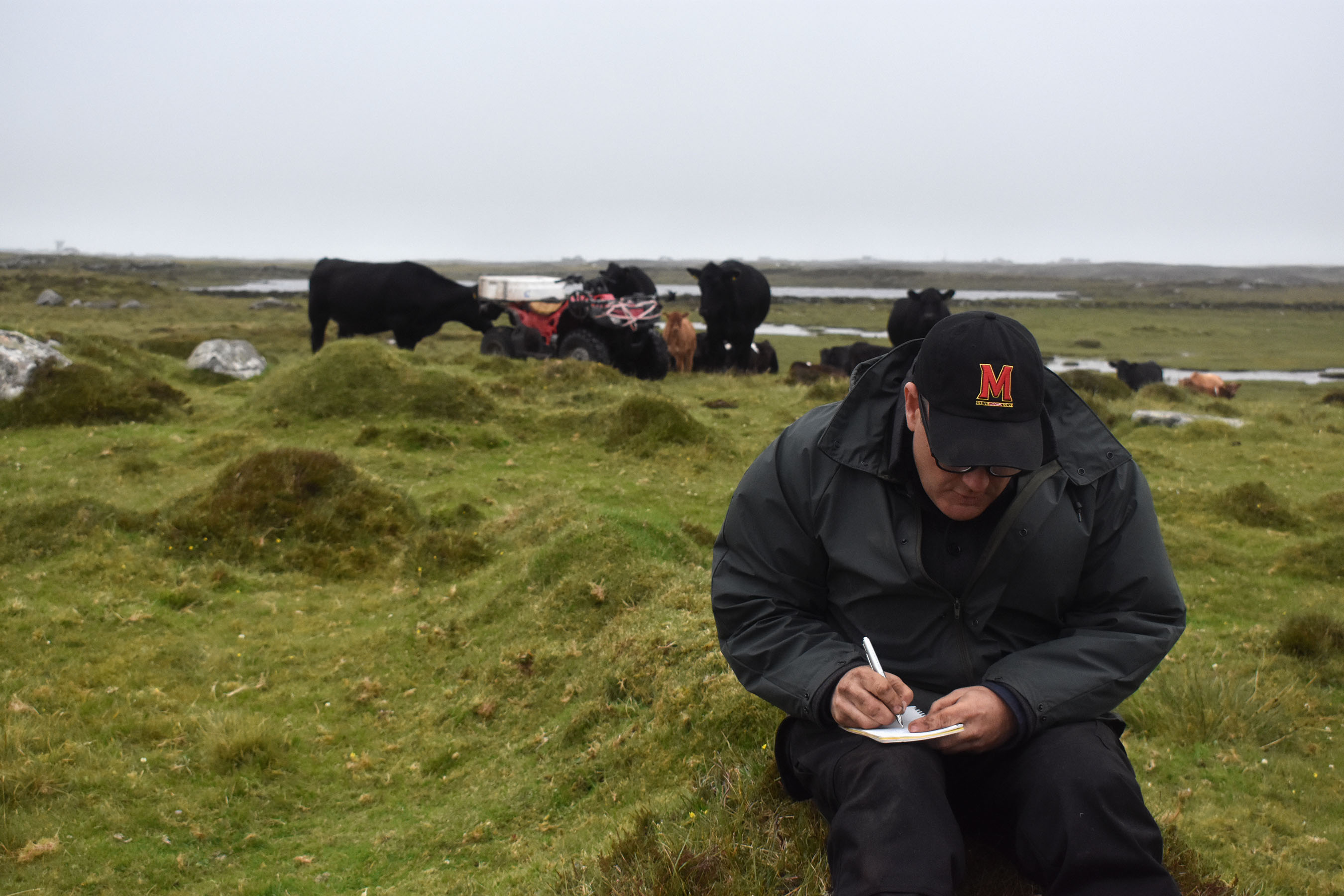
Photo: Nataline Beckley
My research centers on the transformative processes of the early modern period—global culture contact, migration, pandemic disease, species translocation, and the complex dynamics of environmental change. Through the lens of zooarchaeology, I explore how past societies navigated climatic instability, resource management, and ecological transformation.
I have conducted fieldwork across Iceland, Northern Norway, the Caribbean, Scotland's Outer Hebrides, and New York City. My current focus examines the historical ecology of the North Atlantic, using archaeological fish remains and marine climate records to understand millennium-scale patterns in human-ocean relationships.
My work is interdisciplinary, bridging archaeology, environmental history, marine biology, climatology, and genetics. I collaborate closely with marine ecologists, isotope chemists, geneticists, historians, and fisheries scientists to address questions that no single discipline can answer alone. As Director of Undergraduate Studies in the Anthropology Department at UMD, I am committed to training the next generation of archaeologists to think across temporal scales and disciplinary boundaries.
Analyzing animal remains from archaeological sites to reconstruct past human-animal relationships, subsistence strategies, and environmental conditions across the Norse North Atlantic.
Investigating millennium-scale patterns in fish populations and marine ecosystems using archaeological data, stable isotopes, and aDNA analysis to inform contemporary fisheries management.
Examining how past societies responded to climate change, contributing to frameworks for understanding resilience, adaptation, and vulnerability across temporal scales.
Investigating the archaeology of early modern Iceland, the Caribbean, and Scotland—periods of global transformation, colonization, and ecological change.
Leading policy work on climate change threats to archaeological sites, developing strategies for resource management with the National Park Service and international bodies.
Developing methodological frameworks that treat archaeological sites as long-term observation networks for understanding past environmental and climate conditions.
A multi-institutional, interdisciplinary collaboration bringing together archaeologists, marine ecologists, isotope chemists, and geneticists to reconstruct millennium-scale patterns in North Atlantic marine ecosystems and inform contemporary fisheries policy.
Ongoing excavations in Skagafjörður, northern Iceland, at one of Iceland's oldest continuously occupied farms. Students develop excavation, lab, and digital recording skills while contributing to research on Viking Age and medieval settlement.
Exploratory survey and excavation on North Uist and Benbecula, investigating long-term human-environment dynamics on Scotland's western islands through interdisciplinary collaboration.
Contributing to global synthesis of long-term human ecodynamics research, connecting archaeological and historical data to contemporary sustainability science through cross-disciplinary networks.
The UMD Zooarchaeology Lab offers hands-on research opportunities for undergraduate students interested in archaeology, environmental science, and the study of past human-animal relationships. Students gain experience in faunal identification, skeletal analysis, database management, and laboratory techniques while contributing to active research projects.
We welcome students from diverse backgrounds—whether you're majoring in anthropology, biology, environmental science, or history. Lab experience provides valuable preparation for graduate school, museum careers, and cultural resource management.
Interested students should contact me directly to discuss current opportunities and ongoing projects.
Photo: Nataline Beckley
PhD Candidate · Investigating life history changes in Icelandic fish populations over the last millennium using biometric and stable isotope analysis.
PhD Student · Applying biotechnology background to genetic anthropology, working at the intersection of aDNA analysis and archaeological research.
Auggie the UMD Zooarch Lab Lab